Asif Ali Zardari
آصف علی زرداریCo-Chairman of the Pakistan Peoples Party since December 2007, and President of Pakistan.
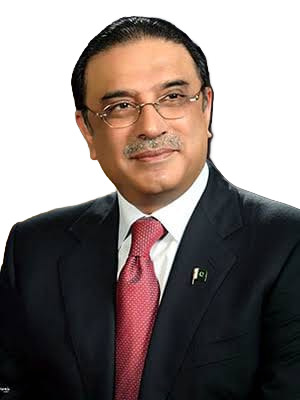
Quick facts
- NameAsif Ali Zardari آصف علی زرداری
- Born26 July 1955, Karachi
- EducationCadet College Petaro
- OfficeCo-Chairman, Pakistan Peoples Party
- Co-Chairman since30 December 2007
- Head of statePresident of Pakistan, 2008 to 2013
- Head of state14th President of Pakistan, since 10 March 2024
- In parliamentMember of the National Assembly, 1990 and 1993; Senator, 1997
- MinistriesEnvironment, 1993 to 1996; Investment, 1995 to 1996
- Landmark era18th Amendment, 7th NFC Award, BISP
The office
The Pakistan Peoples Party has been led jointly since December 2007, when the party's leadership passed to Chairman Bilawal Bhutto Zardari and Co-Chairman Asif Ali Zardari together in the days after the shahadat of Benazir Bhutto. As Co-Chairman he has guided the party's strategy through every government and opposition since, and he chairs the party's Central Executive Committee.
Early life and entry into politics
Asif Ali Zardari was born in Karachi on 26 July 1955 into a Sindhi landowning family, and was educated at Cadet College Petaro. He entered political life through his marriage to Benazir Bhutto on 18 December 1987, a year after her return from exile. They had three children: Bilawal, Bakhtawar and Aseefa.
He was elected to the National Assembly in 1990 and again in 1993, and to the Senate in 1997. He served in Benazir Bhutto's second cabinet as Minister for Environment from 1993 to 1996, and as Minister for Investment from 1995. Across two separate periods, from 1990 to 1993 and again from 1996 until his release on bail in November 2004, he spent roughly eleven years in prison on charges that never produced a conviction. He returned to Pakistan when Benazir Bhutto was assassinated on 27 December 2007, and led the party to victory in the general election of February 2008.
In government
Under the Co-Chairman's stewardship, the party led the federal government from 2008 to 2013. He was elected President of Pakistan on 6 September 2008 and took office three days later.
That government reshaped the constitutional order. The 18th Amendment of 2010 returned autonomy to the provinces and repealed Article 58(2)(b), the clause that had allowed a president to dissolve elected governments: in signing it, he handed powers away from his own office and back to parliament. The 7th NFC Award of 2009 settled a long-running dispute over the distribution of federal resources and gave the provinces a fairer share. The Benazir Income Support Programme, launched in 2008, grew into Pakistan's largest social safety net, reaching millions of the poorest households and putting money directly in the hands of women. The Gilgit-Baltistan Empowerment and Self-Governance Order of 2009 gave the region its own elected assembly for the first time. The independence of the judiciary was restored.
He completed his term on 9 September 2013, becoming the first democratically elected president in Pakistan's history to serve a full constitutional term and transfer power peacefully to a successor.
President for a second time
On 9 March 2024 he was elected President of Pakistan again, and was sworn in the following day as the country's 14th head of state. He is the only person in Pakistan's history to hold the presidency twice.
Reconciliation as politics
The Co-Chairman is known above all for the politics of reconciliation: keeping the federation together through coalition, dialogue and patience, and preferring a settlement that holds to a victory that does not. It is the instinct that carried the 18th Amendment through a parliament of rivals, and that has kept the party at the table through every democratic transition since.
For party workers in Lahore, that approach is why the PPP has remained a national party rather than a provincial one, and why the tanzeem being rebuilt across the ten towns of this city matters to the whole federation.